Fence on Sloped Ground: What to Know Before You Buy?
Uneven terrain introduces real variables into fence selection and installation. These are 2 top metal fencing ideas for a property with hills and curves.
Flat ground is the exception, not the rule. Whether you are securing a sloped driveway, a hillside pathway, or an embankment, choosing the correct fence system from the start will save hours of labor and deliver a cleaner result.
When the ground beneath a fence run is not level, your primary consideration is whether terrain grading or land leveling is viable. Land grading refers to reshaping uneven ground with heavy machinery—including excavating, cutting, and relocating topsoil—to create a smooth, flat surface. While this groundwork may seem labor-intensive and carry extra upfront costs, it often delivers simpler fence installation and a far cleaner, more polished finished aesthetic compared to erecting fencing directly on unmodified slopes.
If grading your uneven lot is not feasible for your project, your remaining solution is to install slope-compatible custom fencing built for angled terrain. When constructing barriers on sloped property, you will need to choose between two industry-standard layout styles: raked fencing and stepped fencing.
Understanding both puts you in a stronger position before you place an order.
Rackable Iron Fence(sloped fencing)
If you’re all about that seamless look, sloped fencing is where it’s at. This style follows the natural contours of your yard, leaving no room for gaps to sneak in at the bottom. Unfortunately, this method doesn’t work for all sloped properties. If your property slope is quite steep, raked fencing is likely not appropriate. The limit is usually about a 12-inch slope across a 6-foot section of ground(or more than 15 degree)so you’ll need to measure to see if it’s viable.
Stepped Fencing
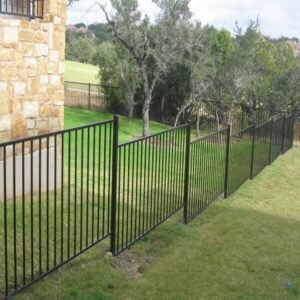
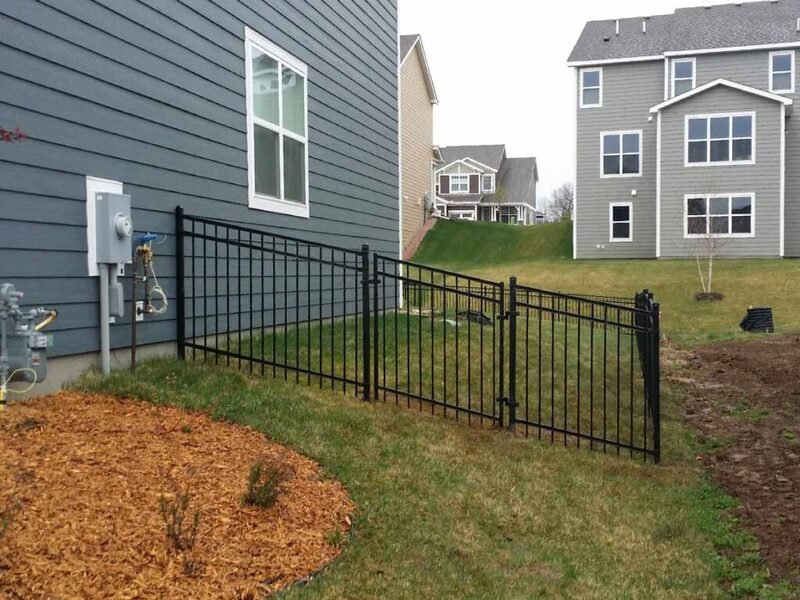
Stepped fencing is another option for sloped properties. It uses rails that are perpendicular to the fence pickets so that every section accommodates the slope of the property. The fence ends up looking like a set of stairs which increases in height as you continue up the slope. stepped fence tends to be simpler to construct.
It’s all about creating a level playing field (well, almost) while navigating the ups and downs of your terrain. But here’s the kicker: there’s likely to be a gap between each section and the ground. So, if you’ve got tiny critters or a pesky pool code to contend with, this might not be your best bet.
Which Option Is Right for Your Project?
For steeper slopes, choose a stepped fence.
For easy installation, choose a stepped fence.
For minimal installation gaps, choose a raked fence.
If the visual outcome is a priority, a raked fence offers smoother lines.
Installation Tips for Both Methods
01 Survey the grade first
Measure the rise-over-run across the full guardrail run before ordering. This determines whether a tilt guardrail qualifies and, for the stepped method, how large each incremental raise needs to be.
02 Set posts before rails
Always anchor your posts at the correct elevation before attaching panels. Adjusting post height after rails are attached is significantly more difficult and risks panel misalignment.
03 Check local codes on gaps
The stepped method leaves a triangular gap at the base of each panel. Many jurisdictions have maximum gap requirements for safety — verify before finishing the installation.
04 Use a consistent step increment
When stepping panels, divide the total elevation change evenly across all panels. Uneven steps look accidental rather than deliberate.
05 Verify tilt-angle maximums
Adjustable-tilt systems have published maximum angle ratings. Running them beyond spec strains the pivot joints and may void your warranty.
06 Concrete anchor depth matters
On sloped ground, lateral soil pressure on posts increases. Follow the manufacturer’s anchor depth specification — and add 10 cm on steep grades above 20°.
We will recommend the most suitable fence system for you based on the slope conditions, local regulatory requirements, and project budget.